Is Ebuka Ok or e-Lite?
Why the NBA Draft Market is Incorrect on Ebuka Okorie

Ebuka Okorie is the 23rd-ranked prospect on the RookieScale.com consensus board1 for the 2026 NBA Draft. The NBA Draft Market is incorrect on its evaluation of Okorie. Here is why.
An Insanely Talented Class
Okorie is a member of a draft class filled with promising 1st round freshman guard prospects. But Okorie hasn’t gotten anywhere near the hype that his one-and-done but not quite in-top-pick-consideration guard contemporaries in this class have received:2
Keaton Wagler (5th on the RookieScale consensus board)
Darius Acuff (6th)
Mikel Brown Jr. (7th)
Kingston Flemings (8th)
Brayden Burries (9th)
This is despite Okorie’s college performance having been right in line with the group of lotto freshman guards’ college performance. In fact, my college performance model has Okorie as the best freshman outside of the “big four” freshman prospects: Cam Boozer, AJ Dybantsa, Darryn Peterson, and Caleb Wilson.
The Case Against Okorie
The case against Okorie comes down to something like the following:
Okorie was more of a scorer with good-not-great vision for a point guard, and his statistical success didn’t seem to translate to team success.
He was not highly ranked coming out of high school, potentially highlighting subpar athleticism, and throwing some doubt on using his one college season of performance as an estimate of his true talent.
Okorie is a small point guard so there are size and potential athleticism questions that muddy the translation of his stellar college performance to the NBA level, particularly with rim finishing and as a potential target on defense.
But case largely falls apart upon closer examination.
Why was Stanford So Bad?
Stanford wasn’t anywhere near the level of team that Illinois, Arkansas, Louisville, Houston, and Arizona were in 2025-26, which explains part of the disconnect between the consensus evaluation of Okorie compared to Wagler, Acuff, Brown, Flemings, and Burries. But Stanford’s struggles had more to do with their complete lack of talent outside of Okorie, as opposed to Okorie himself. Aside from Okorie, Stanford had zero players in the top 500 of my model’s player ratings, a similar train of thought to what I wrote last year in my Dylan Harper analysis:
Why was Rutgers So Bad?
One could reasonably ask: why did Rutgers underperform miserably in 2024-25 if Harper was so good? To which I would respond with my analysis of Ace Bailey and the fact that no Rutgers player aside from Harper and Ace appear in my own college impact model’s top 500 players in Division 1.
The only reason 2025-26 Stanford was even close to as good as it ended up being was because Okorie was a college superstar, which was reflected in his impact metrics:
+7.4 Miya BPR (top 70 in D1)
+8.6 Hoop Explorer RAPM (top 50)
+9.6 Torvik BPM (top 30)
My model has him top 20
The one knock on Okorie’s statistical profile is that for a point guard he was much more of a scorer than a distributor, and his 6.0 assists per 100 possessions to 3.1 turnovers per 100 possessions was not quite elite. But his 23.9% AST% and 8.7 TOV% speak to the fact that Okorie’s raw AST/TOV was hampered by the fact that Stanford needed him to constantly have the ball in his hands and that Okorie was often let down by his teammates’ inability to put the ball in the basket.
Why was Okorie Ranked So Low Out of High School?
Okorie was the consensus 100th-ranked player out of high school.3 While that is substantially higher than Keaton Wagler’s 261st ranking, it is nevertheless much lower than the typical lottery prospect. But Okorie is a bit young for his class, at 19.2 draft day age. As I explained in “Sources of Edge in the NBA Draft Market,” people regularly fail to account for the importance of seemingly small age differences, especially for younger players. That means that Okorie’s net-of-age true talent was also likely underestimated out of high school.
And Okorie’s recruitment was atypical relative to most top 100 prospects. From the outside it appears that he was academically-focused,4 maintaining a 4.0 GPA and originally committing to Harvard over Brown, George Washington, Northeastern, and Rice before shooting up rankings during his senior season of high school and switching his commitment to Stanford very late in the process, in April of his senior season.5
The link between the high school scouting consensus and the offers a player receives is often circular. As we’d expect, highly ranked players are more likely to get power conference offers from top programs that come with large NIL salaries. But the public scouting services are not as well-versed in under-the-radar players from under-the-radar backgrounds and, accordingly, tend to update based on the quality of offers a player receives. This is a perfectly rational thing to do from the perspectives of the public scouting services. But it is nevertheless a phenomenon worth considering when evaluating the relative efficiency of those rankings. If I knew little about players X and Y other than the fact that player X received offers from Stanford, Harvard, Brown, George Washington, Northeastern, and Rice vs. player Y received offers from five power conference programs, which player should I rank more highly?
So in Okorie’s case, there is reason to believe that the high school scouting consensus was more inefficient than it typically is due to his late rise (which itself was likely partially due to being a bit young for his class) combined with his academic focus.
Size and Athleticism
As I wrote in my Cedric Coward writeup last year, “players who were not high on the recruiting radar usually have size and athleticism deficiencies,” but NBA Combine athletic testing revealed that those weren’t really the weaknesses for Okorie that many people feared they might be.
Tawny Park Metrics Combine Percentiles (for PGs):

At the combine Okorie measured with length better than his height. Aside from his 3/4 court sprint, which was shockingly near-identical to notably non-burst-y Keaton Wagler’s 3/4 court sprint, Okorie’s athletic testing was somewhere between “ok” and “very good” for a point guard prospect. And a film evaluation of his speed with the ball is in direct contrast to his his poor 3/4 court sprint time.
I crowdsourced speed-with-the-ball rankings among a select group of similar-ish prospects to Okorie and/or Wagler. My crowdsourcers were a few people with scouting/coaching backgrounds and a few people with modeling/analytics backgrounds. The consensus was the following ranking, in stark contrast to Okorie’s 3/4 court sprint measurement:
Tyrese Maxey
Ebuka Okorie
Tyrese Haliburton
CJ McCollum
Austin Reaves
Keaton Wagler
Brandin Podziemski
My thoughts on the relevance of combine measurements have evolved over time. While Jerry Engelmann has shown that the measurements are directionally useful on top of stats and basic demographic info, they are particularly useful in the absence of a good scouting evaluation of a player. But when the film is in opposition to the (somewhat contrived) combine drills that seem to have poor test-retest reliability, we should lean on the film as opposed to the measurements. Sam Vecenie agrees, noting the following strength in his draft guide’s profile of Okorie:
Legitimate quick-twitch athlete. Doesn’t blow the doors off the place in athletic testing but is extremely reactive to what’s happening around him and has a great first step. More quick than he is fast and moves through tight spaces better than most players. Possesses unbelievable balance. This all starts in transition, where Okorie is as aggressive as any player in the class. Gets the ball and immediately pushes the other way every time to pressure the defense. Blows by opposing players who seemingly have angles on defending him to create looks at the rim. Speedy with the ball in his hands and is seemingly just as fast with the ball as without it. Created four transition shots per game, more than any other player in the draft class.
The Maxey Comp
Okorie doesn’t have quite the blazing speed that Tyrese Maxey did, but he still projects very similarly to the now-All-Star point guard. We need to account for a gigantic Calipari Tax6 for the strange 2019-2020 Kentucky team that:
Underperformed their talent tremendously7
Played a ton of three-small guard lineups8
Used Maxey as more of a shooting guard instead of a point guard
Eschewed threes9 in favor of anachronistic midrange-generating Iverson and Floppy actions.10
But even after mentally adjusting Maxey’s freshman performance for the Calipari Tax, Okorie still projects as the better prospect, especially considering Okorie’s 19.2 draft day age compared to Maxey’s 19.6 equivalent age:11
Maxey per 100 possessions:

Okorie per 100 possessions:

Maxey advanced:

Okorie advanced:

A Maxey-like or poor man’s Kyrie Irving-like upside seems eminently within reach for Okorie. Despite being small guards, Maxey and Kyrie have obviously been very valuable players in the NBA. And Maxey’s NBA career to date also provides a blueprint for generating efficient offense with Okorie’s biggest offensive flaw in his mediocre rim FG%.12 Okorie’s mediocre rim FG% is a bit overblown due to his insanely high percentage of self-created looks and 19.2 draft day age, but it nevertheless projects to be a real issue at the next level due to his lack of size/length.
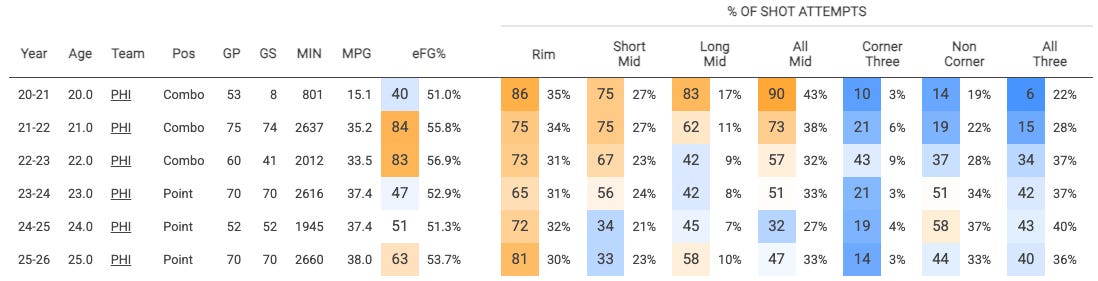
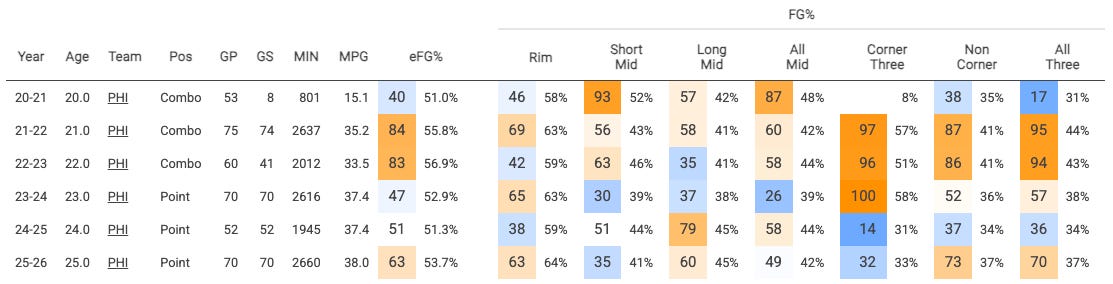
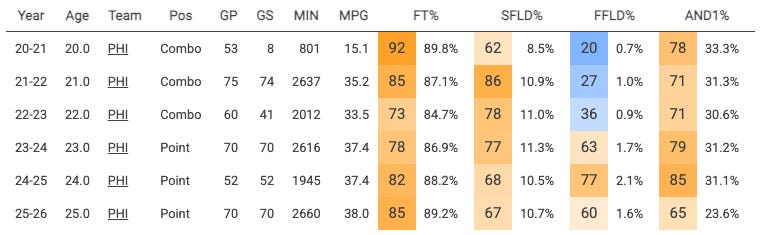
As the Cleaning the Glass Stats tables below show, Maxey is a great shooter and gets to the rim at a great rate for a guard, but his poor size/length leads to finishing at the rim with only middling efficiency. Despite this, because he is able to draw fouls at a very high rate, much like Okorie has done at an elite level in college, Maxey still provides enough three-level scoring which, in combination with his passing ability, serves to function as an offensive engine.
Maxey CTG shooting frequency:
Maxey CTG shooting accuracy:
Maxey CTG foul drawing:
And we just saw fellow small guard Jalen Brunson lead the Knicks to a championship. Of course, to paraphrase Zach Lowe on a recent The Zach Lowe Show podcast, “if you went shopping at the NBA superstar store, maybe you’d rather get someone bigger, but if you’re an NBA team you usually don’t have that choice.” Brunson and Maxey/Kyrie have different offensive strengths13 but Brunson continued to be a defensive point-of-attack target throughout the Knicks’ championship run. Being a defensive point-of-attack target with the heightened advance scouting and more targeted gameplans of playoff basketball is the main reason people have thought, with varying degrees of mistaken absolutism, that “you can’t build a championship team with a small guard in the NBA.” And yet the Knicks won. In general, I think people tend to overreact as opposed to under-react to recent Finals trends, but in this case hopefully it’s now easier for everyone to understand what was true all along:
A championship-winning best-player-on-a-team can have weaknesses and still be a championship-winning best-player-on-a-team.
Championship roster construction may be relatively more about minimizing weak links compared to regular season roster construction. But it isn’t so extreme as to necessitate mitigating every weakness as it is about generating as much value as possible, whether that comes from emphasizing strengths or mitigating weaknesses.
And while I would still project Okorie to be a negative defender at the NBA level, he does have a promising statistical signal in his 2.7% steal rate. He seems to have a better chance than players like Maxey and Brunson of clawing back through turnover generation at least some of the defensive value he will give up as a small point-of-attack target.
Projecting Okorie
So that all adds up to Okorie having a good shot of a valuable actualized NBA game that could be something like Maxey, Kyrie, Jamal Murray, and/or CJ McCollum. At this point, one could argue:
Those players have always had defensive shortcomings over their careers.
Those players haven’t been the tippy-top offensive engines that their more talented co-stars14 have been.
Therefore, those players might have all been overrated by the casual fan for most of their careers.
But in spite of all of the above being true, they have still unquestionably provided a ton of NBA value after progressing past their early growing pains as high-usage, defensively-challenged, score-first guards:
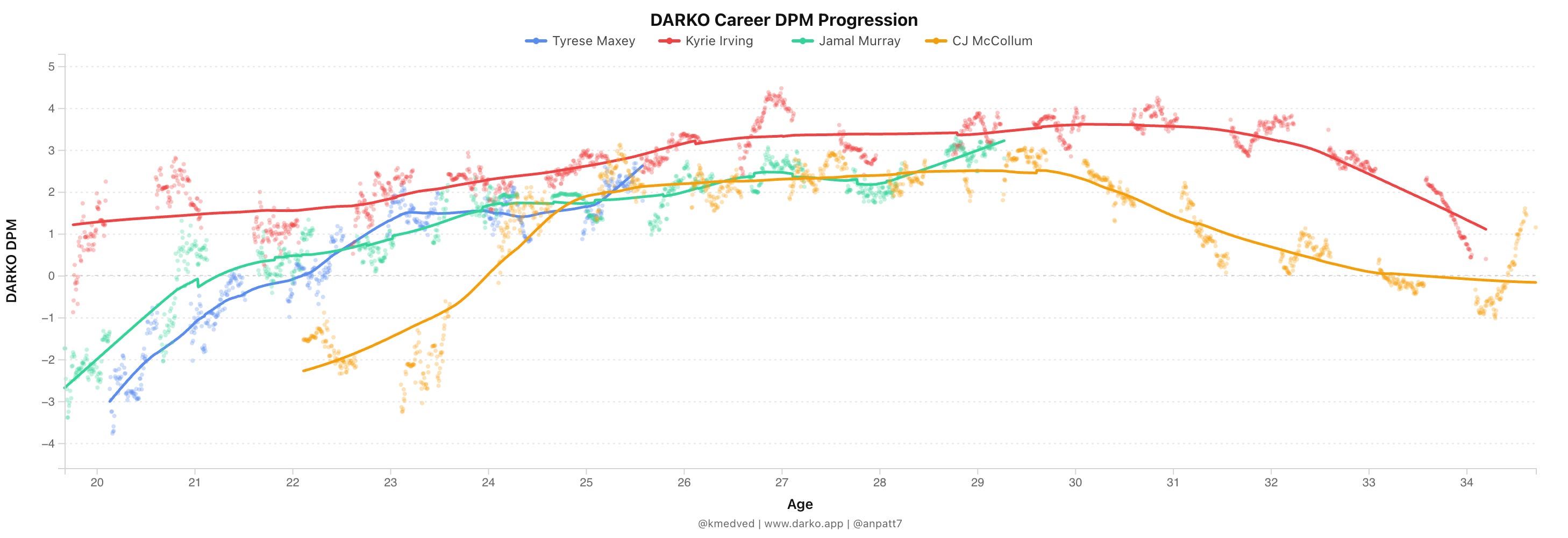
So the EV of a good chance of reaching those kinds of outcomes should be appropriately priced into Okorie’s draft prospect projection despite the obvious drawback of being a small guard. And that’s why I currently have him 8th on my board, in my 8-11 tier of prospects.
A Premortem on Why My Evaluation is Incorrect
Okorie has shown great shooting potential for a freshman point guard with 19.2 draft day age taking tons of self-created looks. That being said, shooting uncertainty is always higher than people seem to think. A 90% confidence interval15 of Okorie’s 3FG% is (29.4% - 41.7%). While a 90% confidence interval of his FT% is (78.6% - 87.2%), indicating that he is almost certainly not at the lower end of that wide 3FG% range, he’s not necessarily guaranteed to be a great shooter. And he needs to be at least good, if not great, to reach his theoretical three-level offensive initiator upside.
More importantly, I could be over-weighting statistical proxies at the expense of a proper film evaluation of Okorie’s vision and passing ability, as I didn’t watch enough of Stanford/Okorie this past season to be able to confidently contradict Sam Vecenie’s analysis of Okorie’s vision and passing:
Okorie is not an elite passer. As a driver, he missed several reads throughout the season in favor of taking difficult shots. Even when he did see the reads, I didn’t always love the execution. Can be erratic with his ball placement and touch.
If Okorie really has more “scorer” vision as opposed to “point guard” vision, then his three-level offense may translate more to “one-dimensional scorer” as opposed to “offensive hub,” a key distinction for NBA value, as I explained in “Sources of Edge in the NBA Draft Market:”
To be clear, shot creation is valuable, but it is especially so when it stresses the defense to defend both the player in question and the player’s teammates. But players like Cam Thomas, Zach LaVine, Julius Randle, and DeMar DeRozan, while incredibly talented, have skillsets much closer to “one-dimensional scorer” than “offensive hub.” And this shows up in their NBA impact metrics27 being underwhelming relative to their skill or talent level.
Lastly, due to aging curves, lottery reform, and extension dynamics of overrated near-All-Stars, Okorie might eventually develop into something like a Maxey-lite or McCollum-lite player but nevertheless not return good value to the NBA team that drafts him. As a high-usage small guard with 19.2 draft day age he is likely to experience more growing pains than most players in his rookie and sophomore seasons. And with recently passed lottery odds reform, those years can no longer be written off (or even treated as a positive) for rebuilding teams. And if he becomes some version of poor defender and one-dimensional scorer then his public perception could create a market that leads to an extension that provides zero asset value, or even negative asset value, to the team that drafts him. That would leave a very small year 3-4 window for him to benefit the team that drafts him. That said, as I wrote in my Ace Bailey analysis:
I do not think that teams should alter their decision-making now to save themselves from themselves later. A rational team should just not offer a -EV extension if it comes to that.
And, anyway, when evaluating Okorie’s EV, the chance of his downside case should still be summed with the very reasonable chance of an outcome as a secondary offensive star who, despite defensive limitations, provides substantial NBA value.
As of 6/17/2026
Darryn Peterson is also a guard, but is in a different tier of prospect, as I explained in my midseason analysis of Peterson.
According to 247’s Composite ranking
Sam Vecenie agrees, stating “Okorie comes from an academically inclined background that his parents strongly instilled from a young age” in his Okorie analysis within his 2026 NBA Draft Guide.
According to Sam Vecenie’s draft guide
I wrote about the Calipari Tax in my Dylan Harper analysis last year.
KenPom preseason rank of 2nd in the nation vs. KenPom end-of-season rank of 29th in the nation
Check out these hilarious KenPom depth chart / lineups visualizations for Kentucky 2019-20:
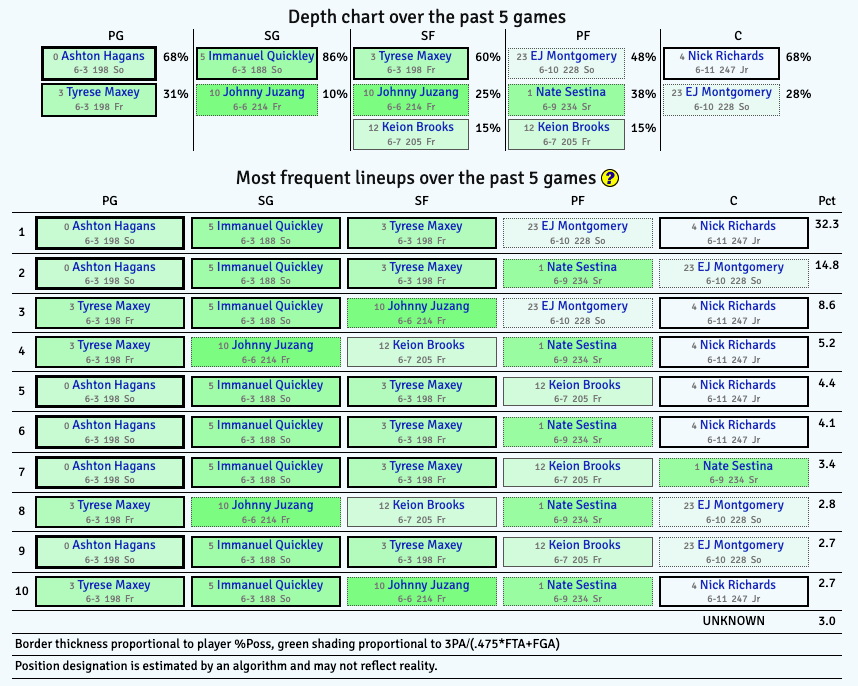
350th in 3FGA rate in the nation, according to KenPom
One could theoretically borrow the advantages of those actions and modernize them to generate threes instead of midrange twos. Alas, Calipari offenses historically have not done so — check out Calipari’s KenPom coach page.
The 2020 NBA Draft was postponed due to COVID-19 but we can simply use Maxey’s age as of late-June 2020 for an apples-to-apples comparison.
56.3% on 240 close twos, according to Torvik
Including Brunson having much better strength itself, pardon the pun
Maxey: Joel Embiid
Kyrie: LeBron James / Kevin Durant / James Harden / Luka Doncic
Murray: Nikola Jokic
McCollum: Damian Lillard
Under the “all models are wrong, but some are useful” assumption of treating each shot as an independent and identically distributed coin flip.
Awesome write up! I had no idea Ebuka was initially committed to Harvard!